

Although the conditions for this election continue to be strong – Trump is unpopular, Republican candidates are flailing and Democrats are fighting hard on every front – there were a few setbacks this week that remind us these next 60+ days won’t come easy.
Trump’s efforts to interfere with voting by mail, new Tarrant County polling place closures and Texas’ 1.2-million voter “suspense list” could each determine how free and fair the midterms will be.
But the important thing in working through these challenges is to keep in mind that no loss and no victory in this struggle will be final. We are going to have to keep pushing until we win. And then continue the fight long after we do.
Back in the old days, say in 2016, it was inconceivable to me that America could roll in reverse. Maybe progress came too slowly, but the direction was, and always would be, forward.
The big historical waypoints — the 14th amendment, the 19th amendment, the Civil Rights and Voting Rights Acts, Roe v. Wade, Obergefell — proved that we traveled a one-way road to enlightenment. “The arc of the moral universe is long, but it bends towards justice.” All of that.
Of course when Republicans got behind the wheel or tried to drive from the backseat — Reagan, Newt, Bush, Boehner, etc. — they’d slow things down, try to take us off course. Democrats in power at times would fail to deliver on the full promise and potential of government — accepting half measures, mediocrity, ineffectiveness — and that could build up resistance to progress as well. But the inertia of 200+ years of momentum, I thought, was just too much for it to stop completely.
Like millions who supported, campaigned and voted for him, when Obama won the White House in 2008 I thought our work was through. We could sit back and watch him deliver on our sky high expectations. Now we were really going to move forward!
But then eight years later, Trump won the White House on a vision that dispensed with choosing the right or left fork in the road, dispensed with forward motion altogether. The entirety of his vision was limited to what could be found in America’s rearview mirror. In 2016 we lost both the election and the illusion of inevitable progress.
But the wakeup could have come earlier, if we’d been paying attention.
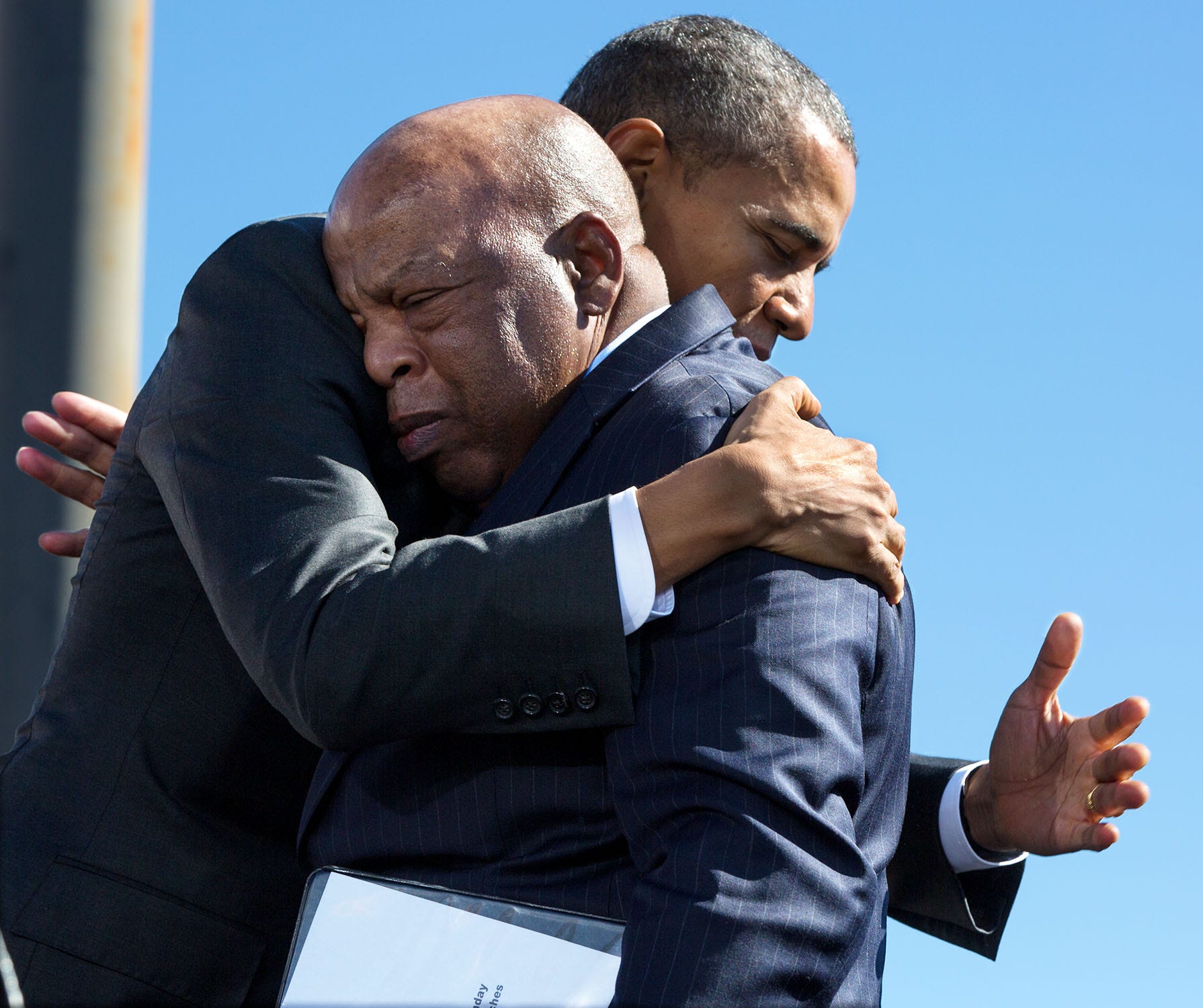
Three years before, the Roberts Court had overturned much of the Voting Rights Act. The one that John Lewis nearly lost his life to win, that LBJ staked so much of his presidency to sign, that took our country nearly 90 years to pass. In Shelby v Holder they decided that racism and election interference no longer threatened the ability of every American to fairly and freely vote. In her scathing dissent, Justice Ginsburg wrote that discarding the law which had produced the closest thing to a true democracy in American history “is like throwing away your umbrella in a rainstorm because you are not getting wet.”
Within minutes of the decision, Texas imposed the most restrictive voter ID law in the country, disenfranchising more than 600,000 citizens who, all of a sudden, couldn’t meet the state’s standard for proving who they were. Over the decade that followed Texas also closed more than 700 polling places, twice the number of the next most restrictive state, and almost all of them in African American and Latino neighborhoods. Congressional districts were racially gerrymandered, voting by mail was restricted and voting locations were moved miles away from colleges and universities.
Without the protection of the Voting Rights Act, politicians were free to not only pick their voters, but they could now choose who could vote in the first place.
It was a preview of what was to come from the first Trump term. Like the Shelby decision that imperiled the fundamental right to vote, the attacks on immigrants, on the Constitution and the rule of law reversed progress that had been won at extraordinary sacrifice over decades.
When Roe was overturned in 2022 by the justices appointed during Trump’s first term, another longstanding milestone of progress was toppled — like the loss of voting rights, unthinkable until it happened. Because only in a fever could you dream that a victory won by three courageous Texas women in 1973 – persuading an all-male Supreme Court that American women had a right to make their own decisions about their own bodies – could be reversed by an adjudicated sexual abuser 50 years later.
But maybe there was virtue in these losses. The scales fell and we were able to see our country and our politics for what it was, not what we wished it to be. We understood that as hard-fought as our forward progress had been, it could be rolled back at the turn of a single election.
What’s been happening over these last ten years and what’s coming to a head right now in our country — this battle between authoritarianism and democracy, between cruelty and decency — is what it’s going to be like for a long time. Maybe the way it’s always been, maybe the way it will always be.
Earlier this summer we briefly celebrated when a federal judge ordered the Trump administration to stop interfering with vote by mail, only to see the Supreme Court decide that, because the Postal Service had yet to publish rules around mail-in ballots, the plaintiffs had no standing. Then, once those rules were published, that same judge again enjoined the administration from interfering with voting by mail. Now Trump is appealing this to a Supreme Court stacked with his chosen justices. They could decide the issue as soon as next week.
We breathed a sigh of relief last month when the Republican majority on the Tarrant County Commissioner’s Court reversed course on their plan to close nearly half of the county’s polling locations thanks to the outrage from their constituents. This is the third-largest county in Texas, home to Fort Worth and a true bellwether in our state’s politics. This week the Court reconvened and decided to close more than 90 of them anyway.
And as Democratic candidates pull ahead in poll after poll in Texas, as we register tens of thousands of new voters and as we overcome attacks on the voting rights of naturalized citizens, we’ve just learned that more than 1.2 million Texans are now on a “suspense list,” meaning that they are required to take action to remedy their registration or may have a hard time voting in November. I met a mother and son in San Antonio this week who told me that of the four members of their household, the three that reliably vote in the Democratic primary are now in suspense, while the one who votes in the Republican primary is not. I am hearing stories like this across the state.
Each of these setbacks are serious but not defining. And if we fight back, they will not defeat us.
In vote by mail, it’s possible that the Supreme Court rules against Trump and upholds the injunction, allowing ballots to go out under the status quo ante and protecting the millions of Americans who rely on this form of voting. And even if they choose to create extraordinary chaos by siding with Trump and allowing the new USPS rules to go into effect, we can work to educate every voter about their rights under these new rules and encourage those who can to vote in person.
In Tarrant County, we can acknowledge that for many voting will be much harder and then work to help those most impacted. The polling site at UT Arlington, home to more than 42,000 students, was one of those closed this week. In response, our organization Powered by People will be at UTA this week registering students, updating registrations for those on the suspense list and personally staying in touch with every one of them to guide them to the next closest polling site.
And when it comes to the more than one million registered Texans on the suspense list who are now unsure about their registration status, we are relentlessly showing up to meet them where they are – in person and virtually – to help them check their status and update their registration. We’ll add to their numbers through the voter registration program we’re running across the state that’s bringing in a record number of new voters. As of this spring there are 1.5 million more voters on the rolls than there were in Trump’s last midterm.
We’ve just got to keep fighting, through the losses, past the wins. It never ends. Maybe the moral arc bends but only when we pull on it.
If we win the Texas governor’s race and pick up enough seats in the state house, we can end the voter purges and allow people to register to vote online or automatically when they turn 18 or become a citizen.
If we elect Democrats to the Tarrant County Commissioners Court we can restore the polling places for as long as we keep a majority. It’ll take hustling every election cycle to keep good people in, bad people out.
If we defeat Trump and the MAGA movement at the polls — like electing James Talarico to be the 51st vote in the Senate — we can pass a new Voting Rights Act that will protect all eligible voters and means of voting, including by mail. And those political rights will stand for as long as we vigorously defend them, against authoritarians and against our own complacency.
No victory, no matter how justified, how righteous, is ever permanent.
That’s a lot of work, a lot of fight in front of us.
But if you’re tired, just remember you’re lucky to be on the front lines. They don’t exist in authoritarian regimes, and we’re not there yet.
As long as you live in a democracy, it’s your privilege to be in the fight.
May it never end.
Ways you can help:
This was an amazing read, Beto, thank you. The battle for Liberalism is forever perpetual. It never ends because every victory is only temporary; each victory only stands for as long as we are willing to remain on the battlefield of electoral politics to defend it.
I am reminded of John Lewis's final line from this amazing 2012 DCCC ad: "The fight continues."
https://youtu.be/Z2MmsC9twbY?si=5rPZSJ3nsacjyp3K
Wow…😢 Long game for sure. Let’s stay hydrated and balanced. Thanks for this… ✌️